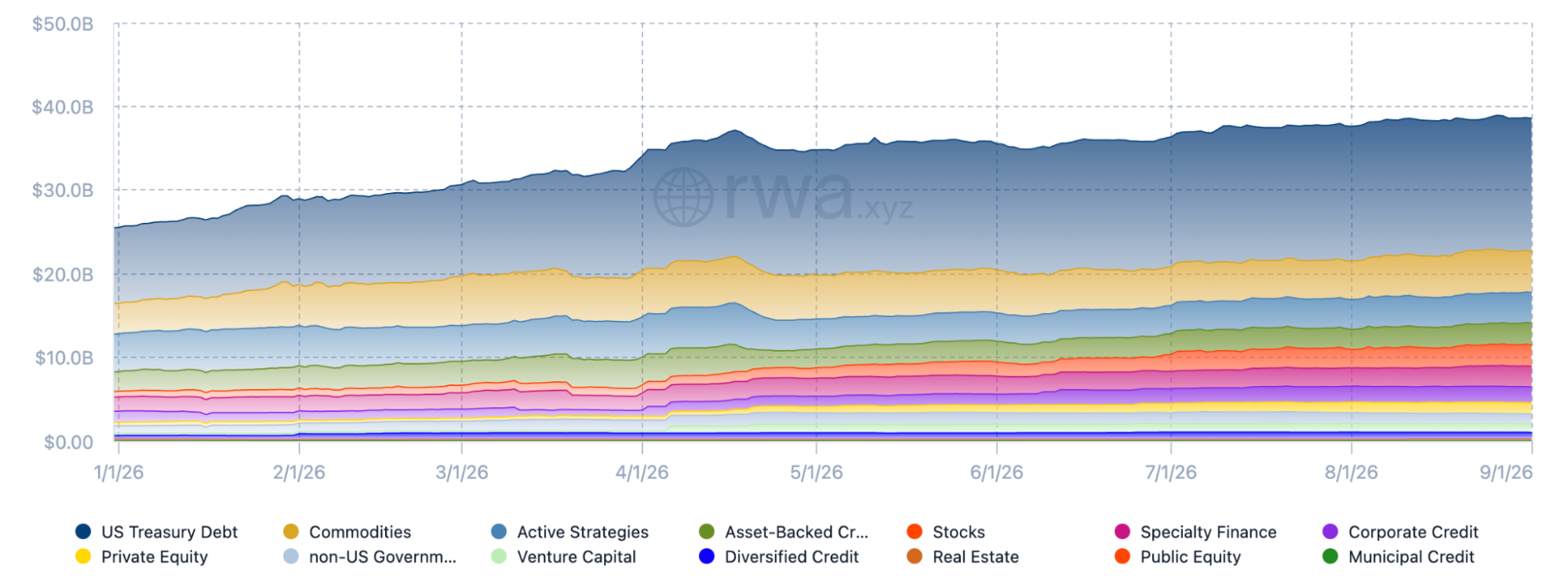
The state of onchain yield has changed during 2026. While DeFi and crypto-native assets entered a slow period, real-world assets (RWAs) have grown 53% since the beginning of the year. The market is seeking more familiar sources of yield that are not crypto-native or strictly correlated to DeFi markets.
However, most of these RWAs signal that the market needs more innovation around yield generation. This becomes clear when we weigh yield-bearing RWAs against the Secured Overnight Financing Rate (SOFR), the benchmark interest rate used for U.S. dollar-denominated loans, bonds, and derivatives.
Onchain yield is often below SOFR despite tokenized products having higher risk profiles than their offchain counterparts.
Beyond Headline APY: Size and Risk
Headline APY is an incomplete guide on its own. The true measure for onchain yield is how attractive it can be over traditional assets in order to justify the risks of adopting onchain technology such as smart contracts, security, and liquidity, as well as compliance, operational, and infrastructure costs. Ideally, they should perform above SOFR, at the very least.
In order to assess the current state of onchain yield in relation to SOFR, we mapped a cross-section of the market's yield-bearing RWAs above $10M market cap against their average 30-day returns and organized them from low to high. This is a snapshot of assets that generate APY through different means such as exposure to U.S. Treasuries, active or mixed-allocation strategies, onchain credit, curated lending vaults, or reinsurance.
The results show that the rates for many of the highest-market-cap onchain assets are sitting below SOFR. This means that "onchain yield" is often getting sub-risk-free rates.
Three Tiers of RWA Yield with Very Different Risk Profiles
From this point of view, we categorize yield-bearing RWAs into three separate buckets according to their average yield rates.
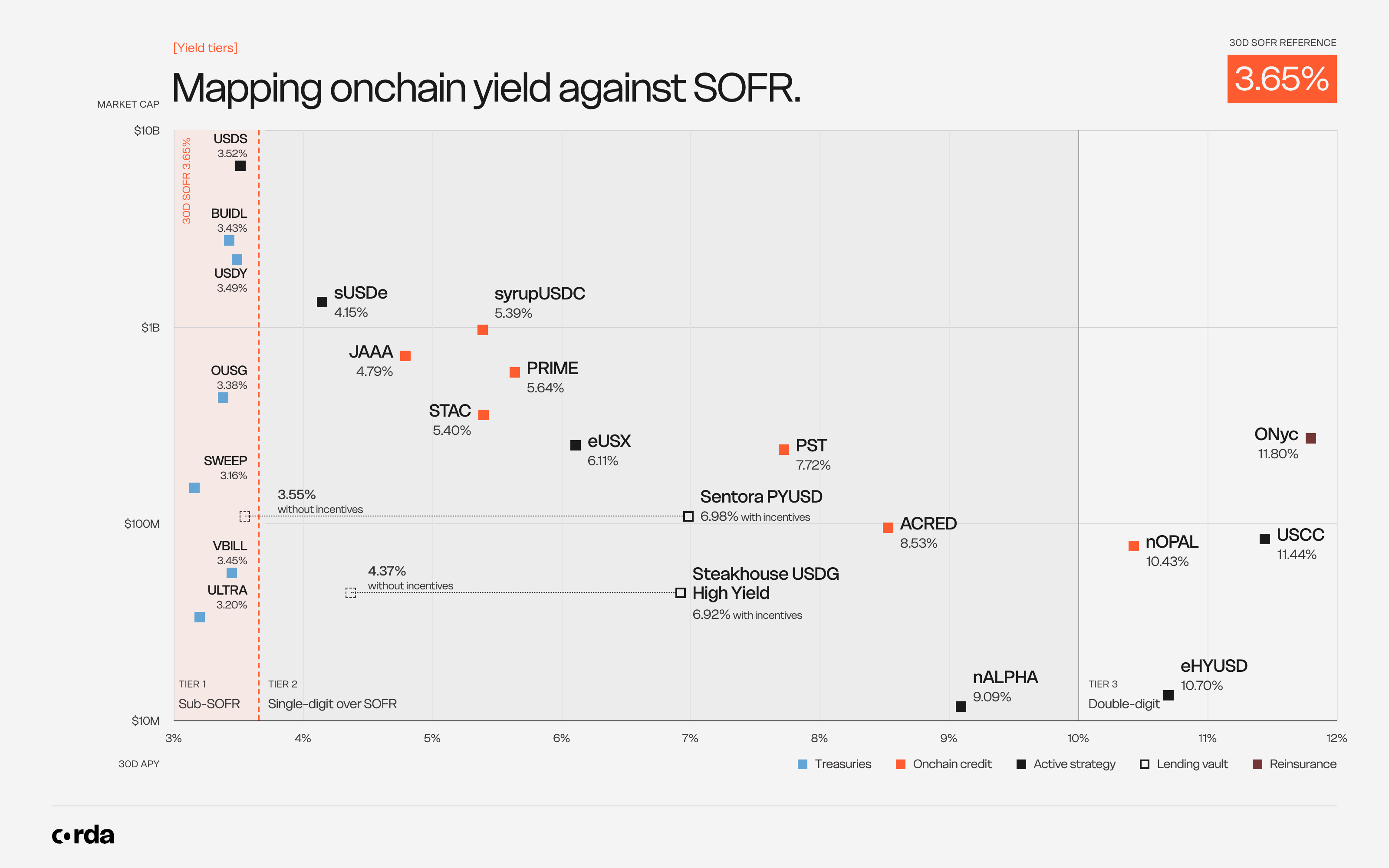
Tier 1: Sub-SOFR — Safe Harbors (Usually)
This is the most conservative tier, and it’s where the market's weight currently sits. Tokenized treasury products and short-duration money-market funds dominate this band. They also dominate the overall plot when we look at market cap size.
The reason why these products sit sub-SOFR is mainly due to short-term interest rates that make up their composition. In some cases, administration fees are also taken into account.
This tier exists mainly for capital preservation and liquidity strategies. The products in this category are less focused on competing on returns.
Tier 2: SOFR+ — What’s Native vs. Incentivized?
This tier is where rates start to become attractive compared to other cryptoassets that are currently in a market lull due to depressed borrow demand and limited staking opportunities that have also affected the price of assets. It’s also where tokenized products experiment with different yield-generating strategies.
The assets are a mix of onchain credit (consumer credit, structured private credit, CLO tranches), active or mixed-allocation strategies, and curated lending vaults that allocate across several underlying markets at once. This lets them run from just above the risk-free rate up toward high single digits.
However, these usually have multiple originators. They are typically a mix of financial institutions who have partnered with players to tokenize assets or DeFi-native curators and risk managers.
We should also note that lending vault products in this band often advertise a rate that includes a token-incentive layer on top of a materially lower base rate. Sometimes that incentive is obfuscated, especially when powering earn programs for CeFi actors. If we exclude the incentive rate, some of the more attractive vaults in this tier quietly drop below SOFR. This can also apply to other yield-bearing assets since not all incentives are at the protocol level or publicly broken down in net APYs.
Tier 3: Double-Digit Reward — Mixed Clarity on Risk
This is the thinnest tier, both in count and, more tellingly, in size. Nothing here approaches the scale of the treasury tier. These returns are generated by riskier approaches to onchain credit, some active strategies, and reinsurance premiums, which carry less standardized risks than the treasuries in Tier 1 and the better-tested strategies in Tier 2. Often these strategies have an upper-bound to size potential or are likely to experience liquidity issues in a constrained market where capital rushes to exit to risk-off.
What We Can Take Away from the SOFR Frontier
- Size and yield move in opposite directions: The largest pools of capital in this market sit in the lowest-yielding tier. The tier with the highest advertised returns is also the one with the smallest total committed capital, often by an order of magnitude or more.
This capital is voting with its size for the conservative end, and treating everything above it as either too small, too new, or too opaque to commit real weight to.
- Rates above SOFR come from experimentation: While Tier 1 mostly consists of products offering a well-understood and legible yield generation strategy, the higher we move up the rate ladder, the more mechanisms we see with less standardization.
We also run closer into a risk that part of the advertised APY number is held up by a temporary subsidy rather than a durable return. Lending vaults tend to disclose this information, but many yield-bearing products benefit from incentives that are not immediately visible to investors. Without incentives, many of these assets are sub-SOFR or likely mispriced in terms of a risk-reward ratio. Paying to bootstrap growth is a classic play, whether the capital is mercenary or will stay depends on the distributor or who owns the customer relationship.
- The appetite is there: There are real opportunities in onchain assets, but most of the value today is still parked in treasuries that are below SOFR and prioritize capital preservation.
As these experimental approaches mature and confidence in the underlying mechanism builds, capital should be willing to move up the yield ladder. When this happens, onchain yield will move past a conservative rate that happens to settle onchain and become a sustainable yield at real scale above the risk-free rate.
There’s a lot to explore about the expanding landscape for RWAs when it comes to yield, how they work, and where they’re headed. We’ll keep you up to speed.
In the meantime, join the waitlist at corda.xyz and get early access to blue chip, SOFR+ assets that are well worth the risk.