Earn programs are exploding right now across neobanks, business-account platforms, treasury management tools, and payments players. They all want a way to let idle balances earn something instead of sitting flat because it gives people a reason to keep a balance there.
But if you've watched more than one of these programs launch, you've probably seen the same pattern: a product goes live with a strong headline APY, deposits come in, and then the APY compresses. Depositors would be better served if they understood the underlying dynamics that produce this long-term compression and make decisions based on risk-adjusted yield.
What’s actually happening with these APYs?
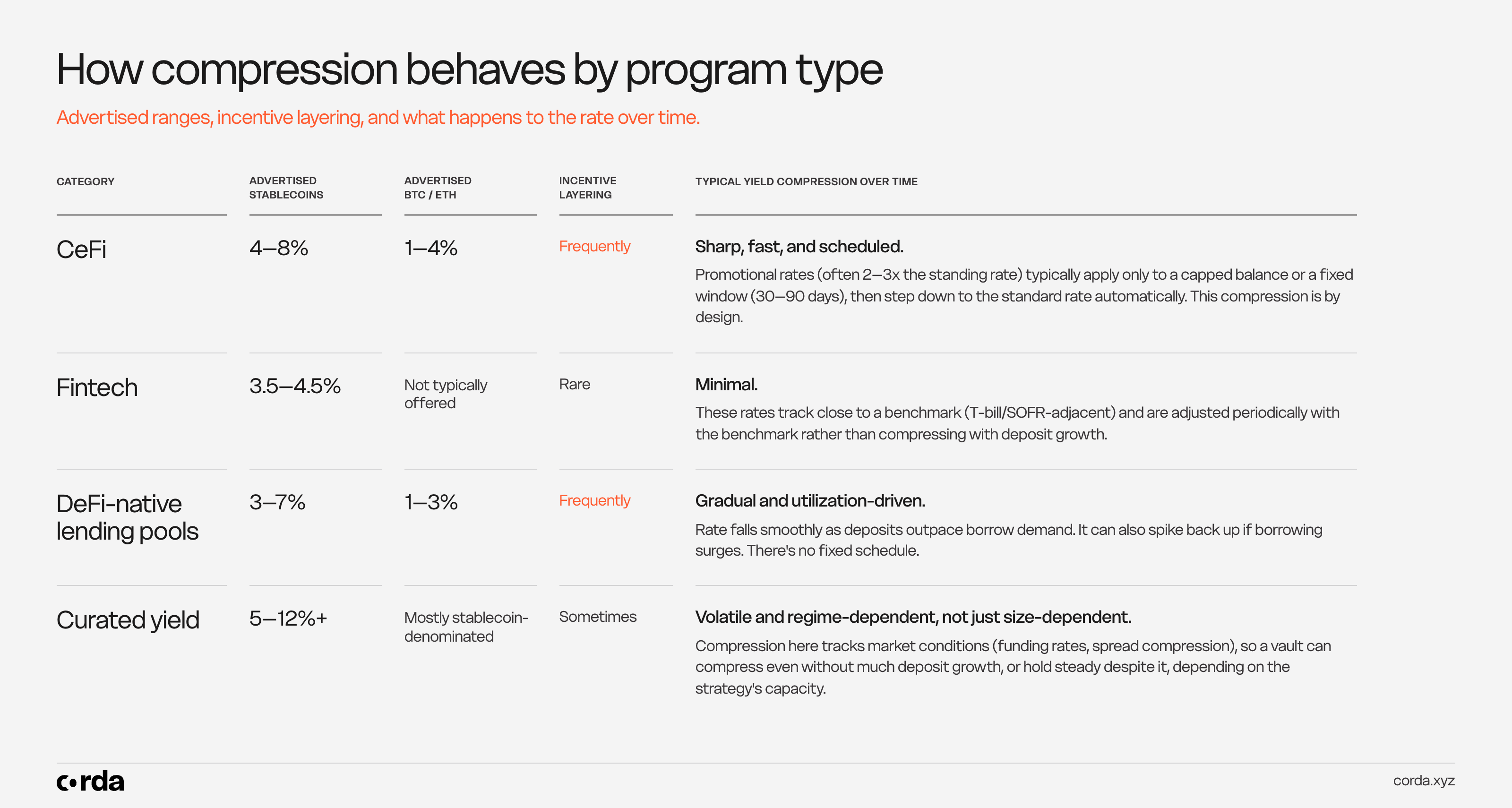
This isn't a symptom of anything going wrong. Most earn programs have complex borrow-lend dynamics driving yield. Their game is one of sourcing borrowers to meet the demand for the supplied collateral. This, in turn, changes rates to account for this via variable borrow rate mechanisms.
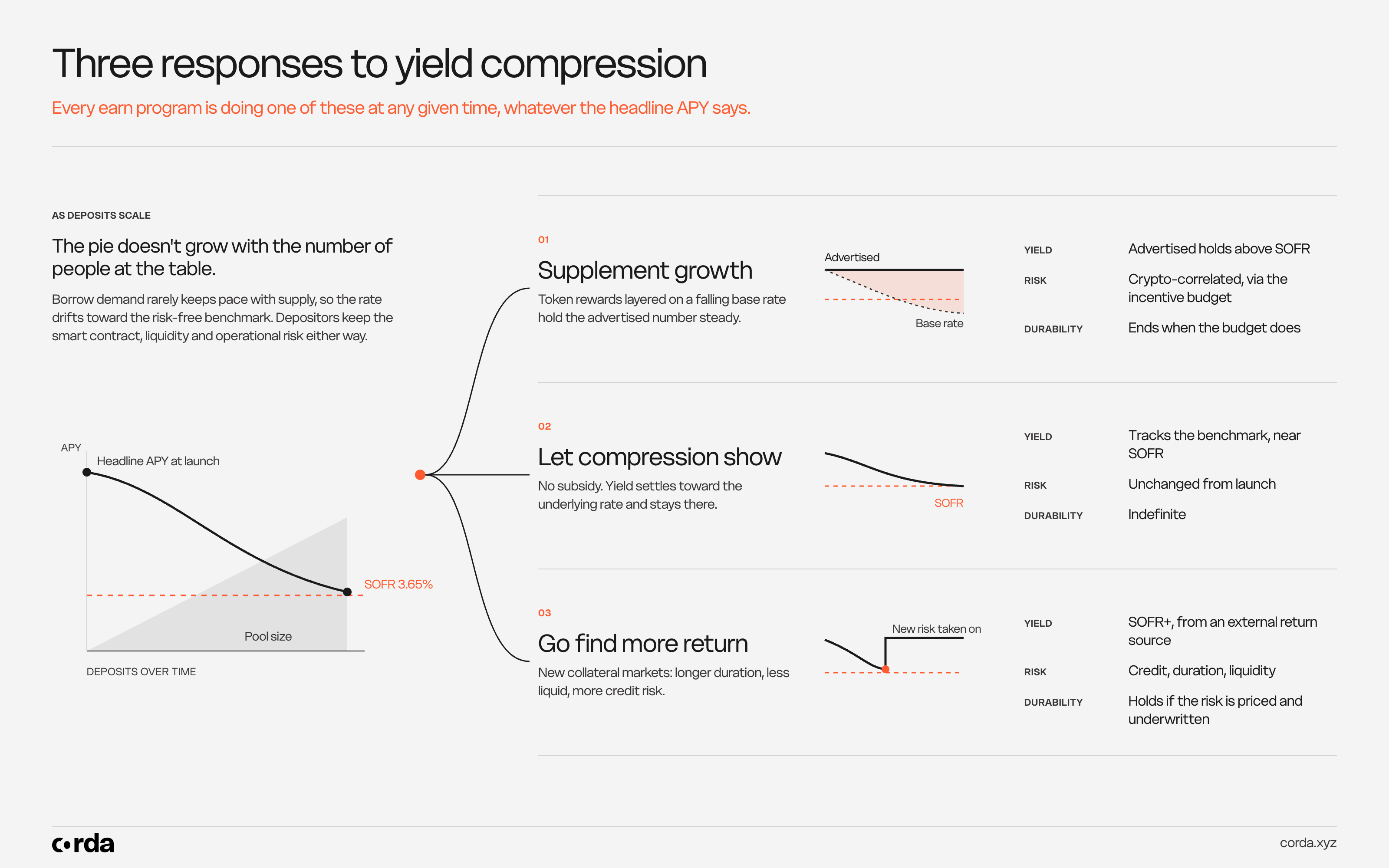
In many cases, however, these rates don’t grow in tandem with however much capital shows up to claim a share of it. In the best of cases, this yield is growing slowly but either way, the pie doesn't necessarily grow with the number of people at the table.
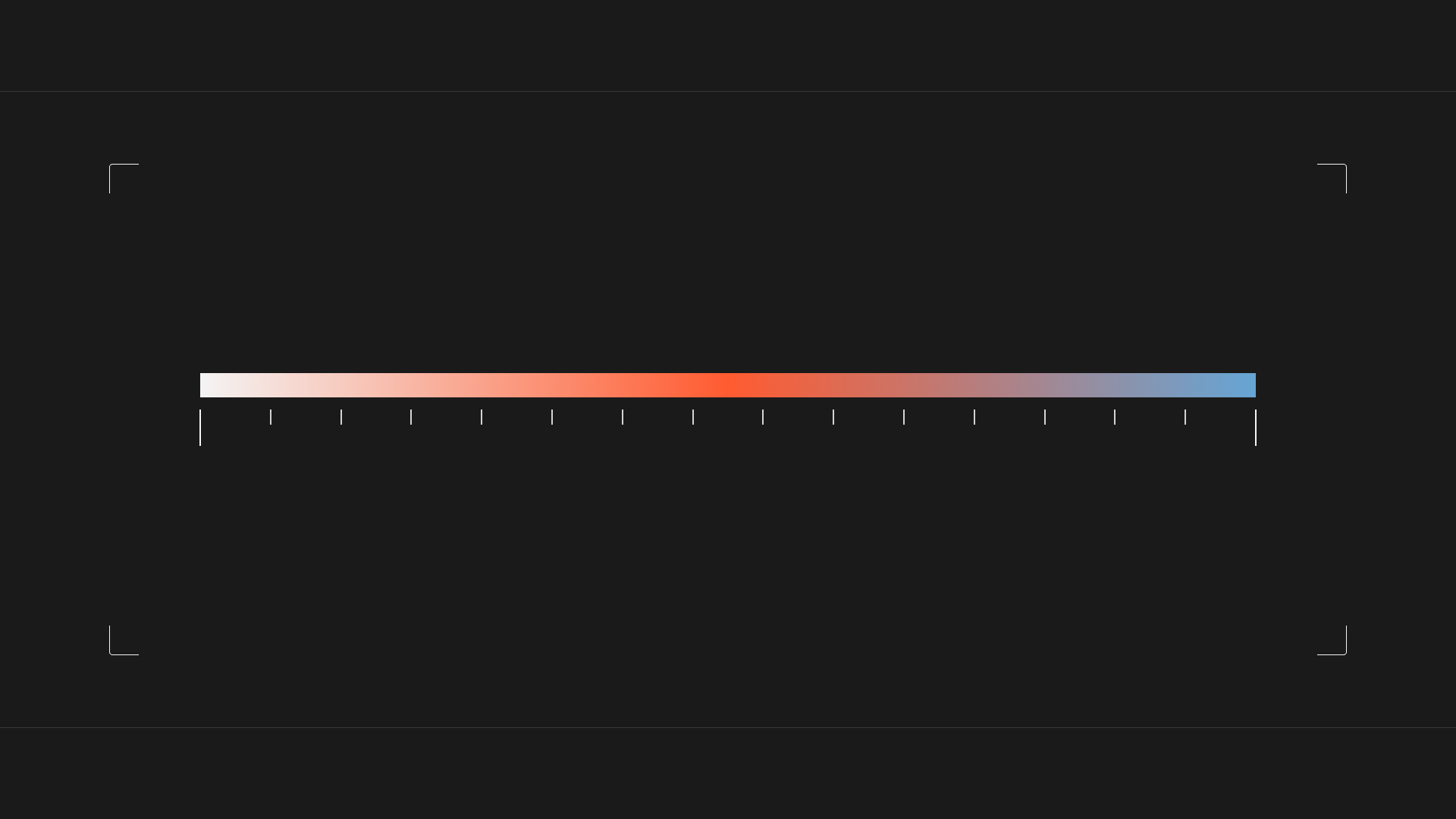
Whenever these APYs arrive at the Secured Overnight Financing Rate (SOFR), which is currently sitting at 3.65% over a 30-day average, this means that a share of what markets itself as "attractive" onchain yield is usually at a risk-free rate. However, depositors are still absorbing smart contract risk, liquidity risk, as well as compliance, operational, and infrastructure risk on top of it.
Why it’s important to understand how earn programs work
The natural response to this compression is incentivization. And this isn't a bad thing. Incentives are a legitimate, useful tool for getting a program off the ground. They bootstrap growth and give a new product something to point to in its first few months. This matters for fintechs, exchanges, brokerages, and anyone running a B2B2C or B2C business trying to get initial traction.
The challenge shows up later, however, when incentives ramp down or run out. In many cases, these incentives are coming from activity native to the crypto markets themselves which means it's correlated with and dependent on the price of BTC, ETH, SOL, and the broader state of crypto market activity and macro conditions.
This makes these programs genuinely difficult to scale sustainably. You can subsidize a headline rate for a while, but you can't subsidize your way past the fact that the underlying borrow demand or activity needs to grow along with deposits, or the whole thing is just a longer runway on the same problem.
For earn programs to actually flourish they need to offer real, risk-adjusted yield, and depositors should know what they're holding. The alternative is that a saver who thinks they've parked money at a savings rate and has actually taken on crypto-correlated market risk is going to find that out at the worst possible time.
Three ways earn programs have been responding to compression
Once a program hits that ceiling, there are exactly three moves available. They will either:
- Supplement growth (incentives)
- Let compression show (decay to base rate)
- Go find more return by taking more risk (move up the risk curve)
Every program is doing one of these three things at any given time, regardless of what the headline APY tells you.
Supplement growth
Many programs offer token rewards layered on top of a declining base rate to keep the advertised number looking competitive while the underlying economics quietly soften. Many programs are upfront about this mechanic and will have an advertised APY that holds steady while disclosing a base rate (what a depositor would actually earn without the token subsidy) that has fallen well below it.
Let compression show
Some programs don't fight the compression at all. In these cases yield settles toward the underlying rate, often somewhere near SOFR, and stays there. Tokenized treasuries are the clearest version of this in the market today where there is no incentive or subsidy and the yield tracks the benchmark it's built on. These are often the assets the attract the most capital.
Go find more risk
On the other hand, some programs sustain a higher rate by changing what they're actually exposed to. This is often done by opening new collateral markets for the borrowed asset, where that collateral is longer-duration, less liquid, or carries more credit risk than what the pool started with. This is where the yield can be genuinely real rather than borrowed from a token budget, but only if the risk being taken on is actually priced and underwritten.
In the RWA space, we see a variety of these real-yield opportunities such as reinsurance, real estate, and tokenized funds. However, they often have unclear risk profiles.
The takeaway and the bigger picture
Compression is structural and every earn program eventually has to choose a lane. It can either subsidize, decay, or take on more risk. In any case, it’s critical for depositors to go beyond the headline APY and understand which lane it chooses.
The bigger picture right now is that allocators are increasingly looking past DeFi-native, incentive-dependent yield toward asset classes with an external return source. Some of these include private credit, tokenized treasuries, and reinsurance-linked structures. Their yield doesn't depend on a token budget but is more so tied to risk happening offchain, which may be harder to price. They’re also places that sit closer to the risk-free rate.
Once capital accepts that it has to take on more risk to find real yield above SOFR, the question becomes: what separates a well-underwritten, risk-adjusted strategy from an incentive problem?
There’s a lot to explore about the expanding landscape for RWAs when it comes to yield, how they work, and where they’re headed. We’ll keep you up to speed.
In the meantime, join the waitlist at corda.xyz and get early access to blue chip, SOFR+ assets that are well worth the risk.