If we plot every major issuer against the category they've brought onchain, we see that institutions have concentrated on what's known to them.
That concentration is a reflection of competence. Treasuries and credit are the asset classes institutions already price, audit, and distribute at scale in traditional markets. They’re the categories where the operational playbook already exists.
Now that they’ve brought the assets they understand best onchain first, it’s time to extend the same standard outward. The logical next step is to bring the same blue chip standards that these institutions offer for Treasuries and credit onto new categories such as structured products.
Today’s asset issuance is all about familiarity
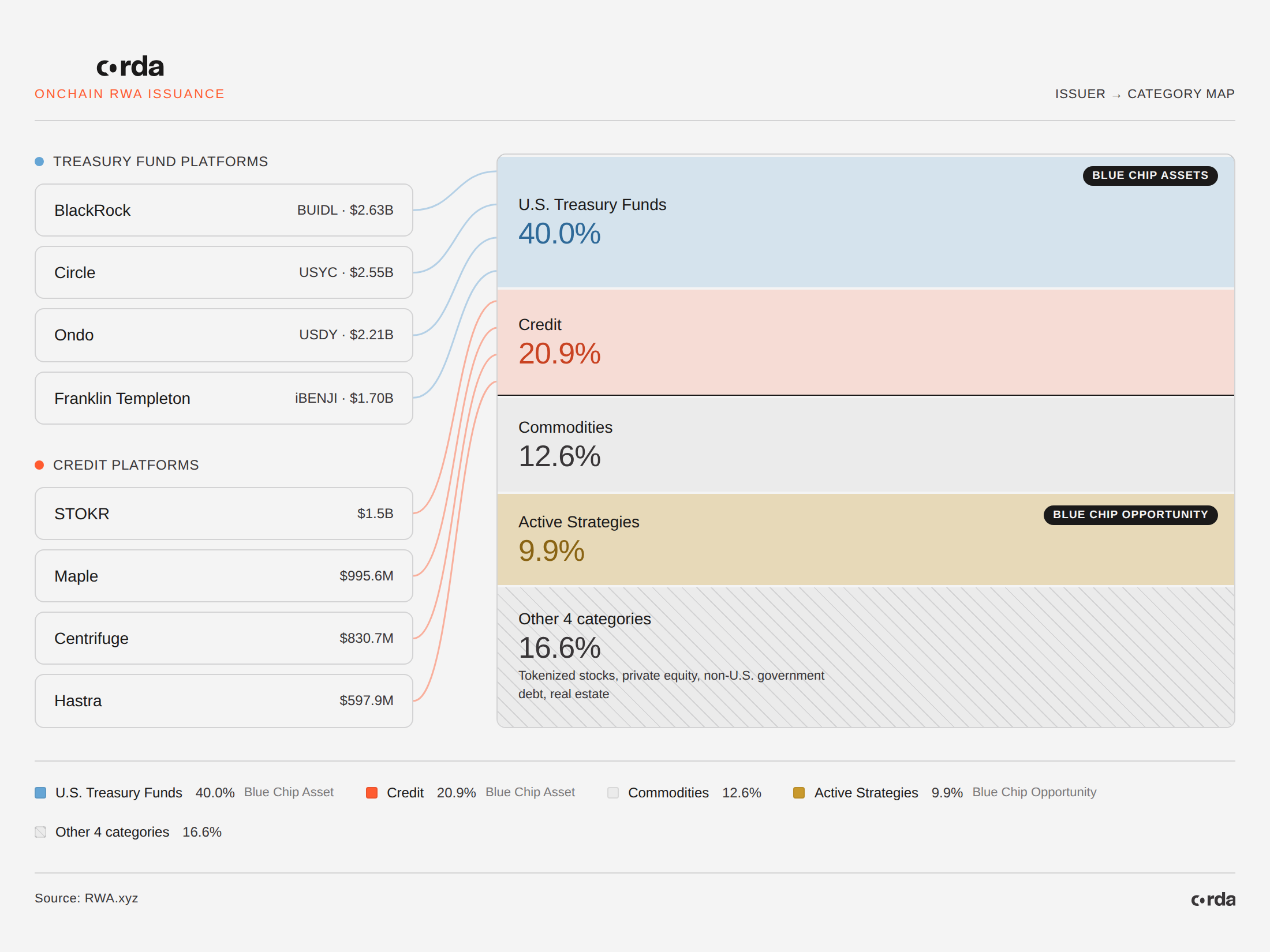
BlackRock, Circle, Ondo, and Franklin Templeton lead U.S. Treasury issuance. STOKR, Maple, Centrifuge, and Hastra lead tokenized credit. Between them, these two categories account for over 60% of non-stablecoin real-world assets onchain today.
Beyond Treasuries and credit, the picture thins out fast. Commodities make up 12.6% of the market, however, they’re made up almost entirely of two tokens, Tether Gold and Paxos Gold. Active Strategies sit at 9.9%, and tokenized stocks, private equity, non-U.S. government debt, and real estate round out the rest, each still small, relatively.
Takeaway: the blue chip standard can be extended to vaults
- Large institutions who have started to participate in tokenized RWAs have all done so through products that are well-known to them.
- Treasuries and credit have earned their place onchain through rigorous issuance, transparent custody, known benchmarks, established audit trails, and existing compliance frameworks. They’re currently the blue chip standard.
- Commodities represent a third major play. However, they’re dominated by two major gold products.
- Real estate, private equity, corporate bonds are still barely represented onchain because these are categories with real illiquidity or valuation risk.
- The next step is extending that blue-chip standard into new categories that are not as affected by long-duration and illiquidity. Vaults are the category that’s ripe for that because they offer real yield, real underlying assets, and can be subject to the same institutional rigor that made Treasuries and credit trustworthy onchain.
The infrastructure is already there
For institutions, the opportunity in vaults would be a leap in the direction of creating more crypto-native products that truly make use of crypto-native rails. So far their product suites have been skeuomorphic translations of products that already exist in traditional finance. But now they have the room to create products that are net-new, with features that could only exist onchain.
This is already something the industry has the technical capability to support. Solana is the venue of record for tokenized equities and a growing multi-chain Treasury venue. It holds ~95% of tokenized equity and most top Treasury products are multi-chain and already include live Solana deployments.
This is evidence that the infrastructure for the next category already exists. Vaults can already run on infrastructure that is high-throughput, low-cost, and increasingly trusted by the same institutions building Treasury and credit products.
There’s a lot to explore about the expanding landscape for RWAs when it comes to yield, how they work, and where they’re headed. We’ll keep you up to speed.In the meantime, join the waitlist at corda.xyz and get early access to blue chip, SOFR+ assets that are well worth the risk.