We've established that RWA issuance has concentrated into large-cap, sub-SOFR capital preservation strategies. These are the offchain products institutions already know how to price, audit, and distribute.
But issuance isn't the whole picture. We need to ask what happens with these assets once they’re onchain. How useful are they? Is this landscape of onchain assets benefitting from opportunities that uniquely exist in composable onchain environments?
Tokenized assets are only useful onchain insofar as they can go places they couldn’t go offchain. This is still not the case for most of them, however.
Where are tokenized assets being used?
With the exception of stablecoins and tokenized treasuries, RWAs are barely used anywhere. Today, a huge share of minted RWAs sits in a small number of addresses and has never been leveraged, lent, looped, or used as collateral. They're just parked, earning sub-SOFR rates and not being optimally put to work in the onchain environment.
The unattractive rates are part of the explanation for why they are inert, but many of these blue chip assets also have a structural problem. They aren’t able to move freely across DeFi and onchain finance protocols because they're created with restrictions against free float. Their onchain transfers are gated, and that gating has a direct, measurable effect on how composable they can be. A handful of exceptions exist, but it all comes down to eligibility checks, where they're placed, and what that placement does to composability.
A gating question
Every onchain asset originated by a top financial institution has to comply with the KYC and AML regulations that determine who's eligible to hold it. Where those checkpoints sit, however, is an important design decision that has second-order effects for how the asset interacts with the rest of the onchain ecosystem.
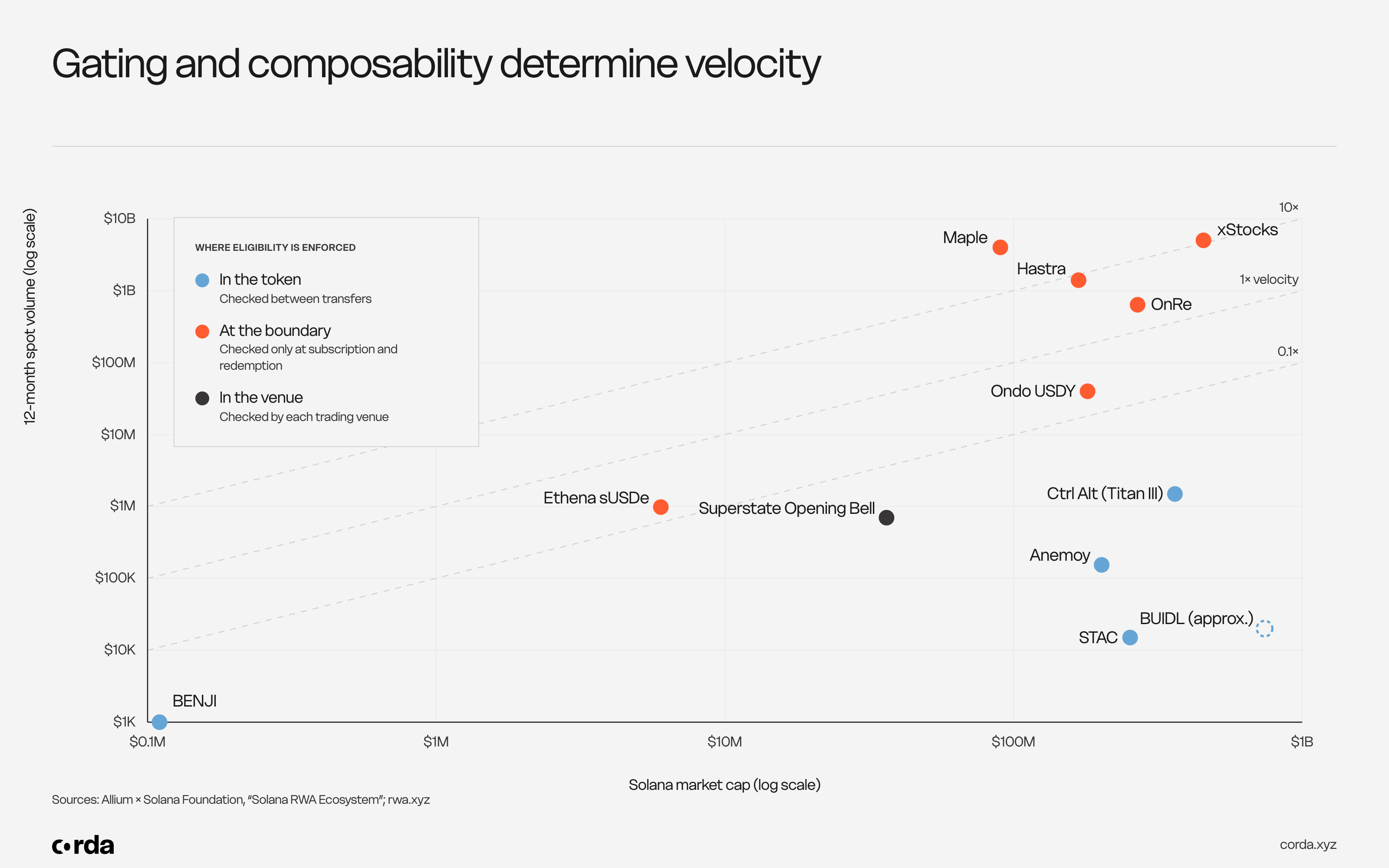
There are three ways eligibility checks can be enforced, and the choice among them is what determines how composable the asset can be:
- In the token: This model is baked in at the smart contract level, and the token standard enforces eligibility on every transfer. However, this hinders composability with other protocols since every counterparty contract, every pool, every reserve, every liquidator must be whitelisted or the transfer reverts.
- At the boundary: This approach checks eligibility only at subscription or redemption, and compliance is treated as a perimeter around the token instead of a property of it. It is the most composable of all gating methods because the token retains the same basic smart contract structure used by any crypto-native asset and preserves the open, permissionless nature of onchain finance.
- In the venue: Here, eligibility rests with the trading venue rather than the token. Each venue maintains a persistent allowlist and admits only participants it has already vetted, so gating stays active wherever the asset trades. The token itself can be a standard contract, but its composability is bounded by the venues willing to enforce that allowlist, so it moves freely among permissioned venues, not across open DeFi.
None of these approaches are mutually exclusive. Each part of the onchain finance stack can tailor their KYC and AML practices to help strike the right balance between compliance and composability. For example, an issuer adopting an at the boundary model can choose to partner exclusively with permissioned venues even if the token itself is still free-floating.
Composability and velocity are correlated
If we plot large-cap tokenized assets on Solana and examine their 12-month spot volumes, we find a correlation between how gating is handled and each asset’s velocity. This implies that the more composable approaches to gating allow assets to participate in the broader DeFi ecosystem and the opportunities therein.
The composability frontier and the wrapper workaround
Setting eligibility checks in the token or in the venue works fine for capital-preservation strategies where access to wider DeFi opportunities is not a priority. But the next step in the evolution of onchain finance will require blue chip assets to be usable in the wider DeFi markets where the new opportunities actually exist. That will be determined largely by their composability and how well asset issuers and onchain applications can work together on compliance.
Many large assets have already begun this transition towards greater composability. Rather than loosen the base token's gating, issuers have started layering a second, freely transferable token on top of it. These gated assets stay exactly as restricted as before, but the wrapper exists as a separate, parallel instrument that claims a right to the underlying asset. The growing use of this wrapper model shows that composability is essential to these assets' next chapter.
There’s a lot to explore about the expanding landscape for RWAs when it comes to yield, how they work, and where they’re headed. We’ll keep you up to speed.
In the meantime, join the waitlist at corda.xyz and get early access to tokenized assets from the world’s blue chip institutions.