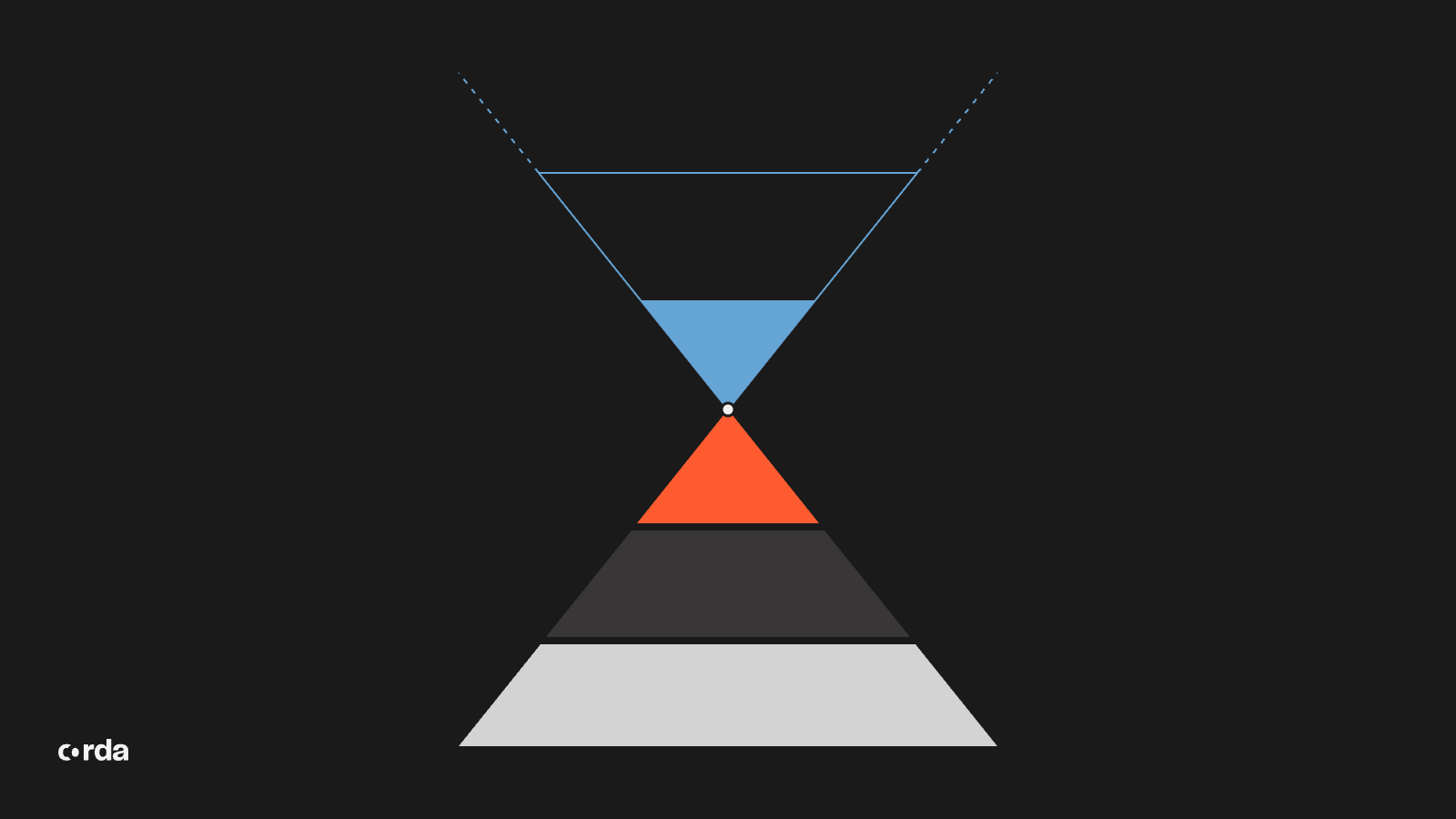
Tokenization has evolved for over a decade now. It's gone through three distinct phases, each making traditional financial assets more available and usable onchain. First it was about bringing them onto private ledgers, then onto public chains, and now into DeFi markets.
The next and fourth phase will be more of a singularity moment than a linear step forward. Real-world assets (RWAs) have found their footing on Solana and are about to gain financial capabilities that were originally exclusive to crypto-native assets.
Phase 1: Permissioned ledgers and "blockchain, not crypto"
Asset tokenization started with permissioned ledgers that shared asset information privately between subscribed participants. During this time, many companies were focused on blockchain applications purely from a database perspective. They stayed away from crypto, which had less sophisticated infrastructure at the time.
Banks, insurers, and trade groups funded permissioned networks and consortia. The premise was that a shared ledger could improve recordkeeping and remove the reconciliation work that happens when every institution keeps its own books.
These networks largely delivered on their technical promise, but between 2022 and 2023 several consortium networks closed, while others evolved into different asset tokenization solutions. Those that didn’t take off failed to scale beyond the members who built them, and their commercial viability came into question. (Ask ChatGPT)
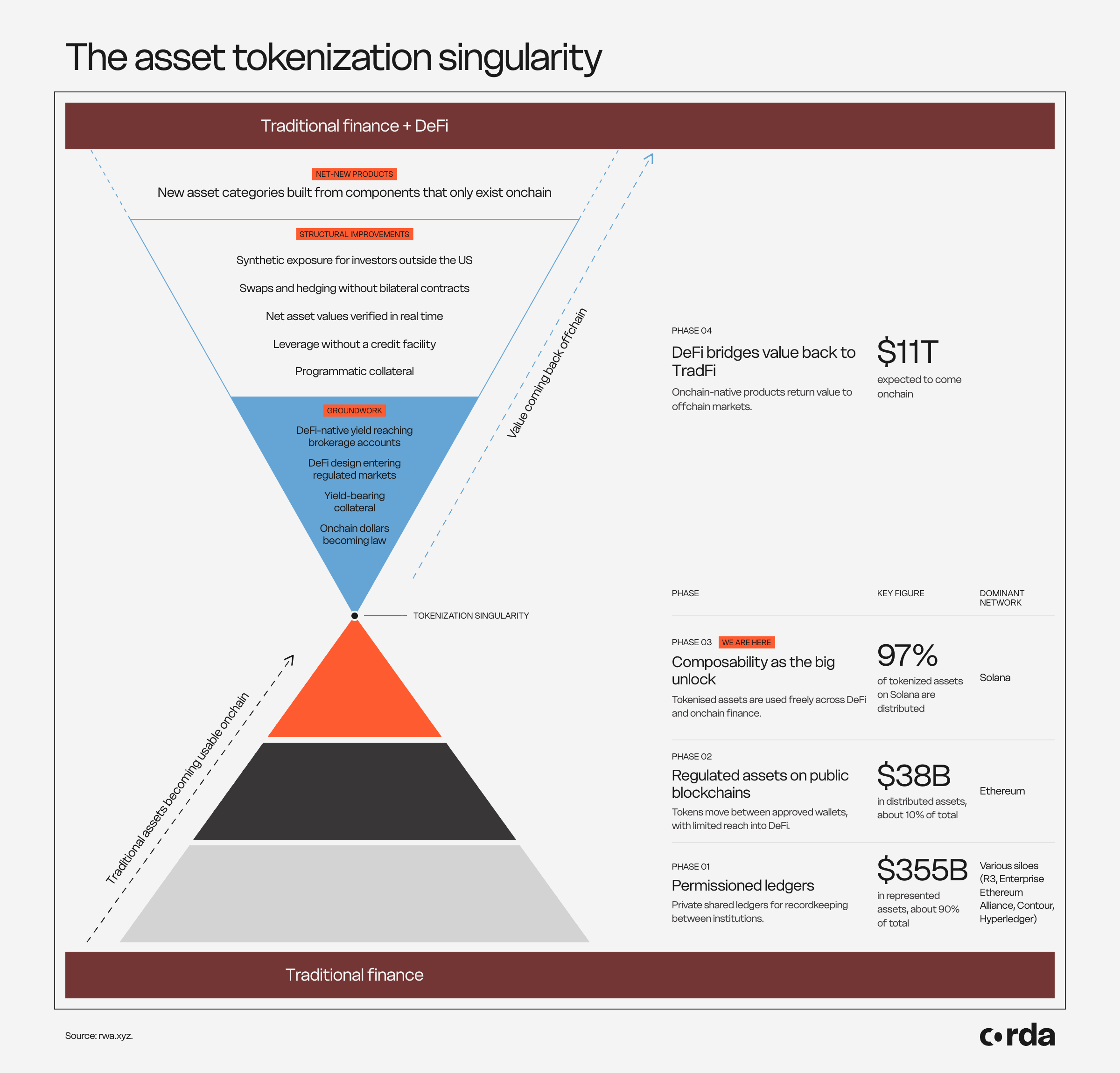
The groundwork laid by these efforts is still here, however. Today, there are over $355B in "represented" tokenized assets, where "the blockchain serves as a recordkeeping and reconciliation layer for institutional participants" according to rwa.xyz. That's about 90% of all tokenized assets.
Overall, the infrastructure partners that enabled these experiments expanded and continued to bring assets onchain through new approaches. Permissioned ledgers worked, but the industry evolved past the closed-network approach that had capped their distribution.
Phase 2: Regulated assets on public blockchains
The second phase brought regulated assets onto public chains, issued as tokens that could be transferred between wallets, albeit with certain restrictions. This gave holders intraday settlement and reach to new investors. Distributed assets are now worth over $38 billion.
But most of these assets were simple translations of instruments that already existed offchain. Although they had broader distribution than assets on permissioned ledgers, they were still limited in how they could interact with the rest of onchain finance. In order to move fast, asset issuers deprioritized composability due to the complexity of building this into highly-regulated, centrally-backed assets.
Security tokens, which replicated traditional securities, were a notable example. They came with eligibility controls where every holder and venue had to be approved in advance. This made them hard to use in decentralized finance (DeFi) protocols, which are permissionless by nature.
Issuance and distribution were covered in the first two phases of asset tokenization, but that was not enough to make tokenized assets fully usable. The lack of composability limited the broader circulation of tokenized assets in many respects.
Phase 3: Composability as the big unlock
This is the phase we're in now. Tokenized asset issuers have started to solve the composability problem and many of their assets are now used freely across DeFi and onchain finance protocols. Approaches ranging from wrapping to lighter gating on transfers are all contributing to the shift.
We can already see increased demand for these assets across the onchain ecosystem. RWA deposits into DeFi lending markets and exchanges went from $2.3B to $7.4B between Q2 2025 and Q2 2026. Perpetual futures on real-world assets reached a record $100B in monthly volume in June 2026. Vaults are also exposing these assets to strategies that can only exist onchain.
Solana is currently leading this trend in terms of velocity. The network accounts for 47% of RWA trades and has seen a steep rise in the velocity of tokenized assets that use at-the-boundary gating. It also holds the highest concentration of holder addresses according to recent report by Pantera Capital.
This may be because Solana has become a home for more composable and useful RWAs. Across all chains, about 90% of tokenized asset value is "represented," meaning that it is locked to the platform that issued it. On Solana we see the opposite scenario where $4.32B is distributed and only $125.86M is represented, so about 97% can move.
All of this signals that the next step in the evolution of tokenized assets will be determined by their composability with DeFi. In this context, it’s likely that the tokenization singularity will happen on Solana.
Phase 4: DeFi bridges value back to TradFi
The first three phases moved traditional assets onchain and brought capital to onchain finance. The fourth will return value to the offchain world by dramatically improving how assets operate, how they're used, and what markets they can participate in. This is especially meaningful as over $11 trillion in assets are expected to come on chain by 2030 according to some estimates. (Ask ChatGPT)
The groundwork is already being laid for this to happen:
- DeFi design entering regulated markets: On September 17, 2026, the SEC issued an "Innovation Exemption" allowing onchain trading of tokenized US stocks through "permissioned automated market makers and liquidity pools." The automated market maker, where prices are set by a pool rather than an order book, was invented in DeFi. It is now arriving in US equity markets, adapted for regulated participants. The next likely step is that these exemptions will be extended to other asset classes.
- DeFi-native yield reaching brokerage accounts: Staking, the process of committing tokens to secure a network and earning rewards for it, is a crypto-native yield source that is now packaged in exchange-traded products. US Solana ETFs drew a record $188 million in net inflows in the week of September 21–25, 2026, extending a streak of more than 12 straight weeks of inflows.
- Yield-bearing collateral: In traditional markets, posting collateral usually means giving up yield on it. Major exchanges now accept tokenized Treasury funds as institutional collateral, so the collateral keeps earning while it secures a position. The CFTC has opened a formal initiative on tokenized collateral in derivatives markets, signaling that regulators see this as more than an exchange-specific feature.
- Onchain dollars becoming law: The GENIUS Act, signed on July 18, 2025, created a federal framework for stablecoin payments. The settlement asset that underpins most of DeFi now has a legal foundation traditional institutions can rely on.
As more of the infrastructure and regulatory landscape falls into place, we'll also see structural improvements to processes that are too expensive, slow, or impossible today:
- Programmatic collateral: Traditional collateral movements are subject to business hours and delayed settlements. Tokenized collateral can move programmatically, at any hour, and settle in minutes. This will create new market efficiencies and automated markets that operate around the clock.
- Swaps and hedging without bilateral contracts: Hedging interest-rate or price exposure traditionally depends on bilateral agreements between counterparties. Onchain markets can offer the same economic outcome through pools and standardized contracts that any eligible participant can access.
- Leverage without a credit facility: Today, an investor who wants levered exposure has to sign a contract, arrange a loan, and wait for approval. Onchain, the investor can lever the same position by posting it as collateral in a lending market. There is no credit facility or bilateral negotiation involved, just the position and the terms.
- Net asset values verified in real time: Fund valuations are typically reported after the fact, sometimes days or weeks later. The infrastructure to publish and verify net asset values (NAV) onchain, continuously, is already live. For investors and auditors, this creates a new layer of data transparency around what they hold. Instead of waiting for a report and trusting it, they can verify NAV independently at any time.
- Synthetic exposure for investors outside the US: Perps already give onchain traders exposure to assets that are difficult to reach through traditional channels. These tools could soon be applied to other RWAs and open up greater asset distribution in offshore markets for assets such as real estate.
Perhaps the most interesting developments in the next phase of asset tokenization will be net-new products rather than better versions of existing ones. The tokenized assets we'll start to see will go beyond simple translations of offchain products and experiment with onchain-native designs. They will be entirely new categories built from components that only exist onchain.
RWAs are about to enter a critical new phase in how they generate yield, how they work, and where they're headed. We’ll keep you up to speed. In the meantime, join the waitlist at corda.xyz and get early access to blue chip, SOFR+ assets.