In traditional finance, holding a blue chip typically means holding a reputable asset that is stable, with sound financials, and provides steady yield. Onchain, the category has no definition. Assets are being tokenized quickly, but the standards that should apply to them are not clear yet.
Many of the characteristics that make an asset blue chip offchain apply onchain. Reputation and yield are still relevant. At the same time, there are new standards such as composability and distribution that are particular to onchain finance.
A tokenized asset should meet five requirements in order to be considered a blue chip. It should have a trusted issuer, yield above SOFR net of costs, real distribution, composability, and a clear path to redemption. Below, we will look into what each of these means and how to test for them.
1. Trusted originator
A recognized originator and issuer should stand behind the asset and the holder's claim should be clear and enforceable.
What to look for:
- Credit quality: The credit quality of the asset originator is disclosed in the offering documents, not just implied by a brand on a landing page.
- Clear claims: The documentation, sales materials, and backtest must clarify the operating company, SPV/SPC structure, and regulatory jurisdictions so holders are clear on what they own and against whom.
- Independent verification: Audits, monitoring, incident response, and key protection are executed and documented by third parties.
There are many assets from reputable originators in the market today and they rely on robust tokenization technology. The largest names on the originator and issuer map are recognized managers and banks. These originators have concentrated on the assets they already know how to price, audit, and distribute, but in most cases their rates aren’t the most appealing.
2. SOFR+ yield
The asset earns more than the Secured Overnight Financing Rate (SOFR), net of costs, and its yield comes from a non-incentivized source.
What to look for:
- Net yield: The rate exceeds SOFR after management fees, wrapper fees, and mint and burn costs.
- Risk-adjusted yield: Holders take any applicable risks into account and are aware of what risk they’re being paid to carry.
- Clear sources: The yield source is known and sustainable to holders and not just a temporary marketing incentive.
An asset that merely tracks the risk-free rate fails this test, however strong the issuer. Treasury funds and credit together make up about 61% of non-stablecoin tokenized assets. Treasury funds are built to track the risk-free rate and grow at the rate of the overall crypto industry. This leaves a thin spread once fees are paid. Credit rates are wider and less uniform since they range from about 4% to 11%. These assets are optimal for holders seeking capital optimization strategies but don’t capture onchain demand.
3. Distribution
Many distinct addresses actually hold the asset in support of a large issued value.
What to look for:
- Holder count: Number of addresses holding the asset against the total value locked (TVL)
- Median holding size: How the total supply is distributed among holders.
- Legal reach: Which investors are qualified to hold the asset across different jurisdictions.
Some of the largest tokenized balances sit with few holders. That concentration limits how useful those assets can be, and it usually results from infrastructure decisions made by the issuer. The majority of tokenized assets today still sit in permissioned networks where they are represented onchain but not distributed. They are held by a small number of addresses and can’t be transferred freely.
4. Composability
The token is compatible with other protocols and can move freely among them.
What to look for:
- Boundary-gated design: A standard token with no transfer hooks, with eligibility checked at mint and redeem rather than on every transfer.
- Meaningful integrations: Availability on lending venues, AMMs, and collateral listings that hold non-trivial value.
- Velocity: High trading volume against market cap. Holder count should also be taken into consideration to check for manufactured volume.
A tokenized asset needs to be composable in order to take advantage of the opportunities in onchain finance. This depends greatly on its gating model. When eligibility is checked at the boundary, at mint and redeem, the token can be used freely in any protocol and has over 10x higher velocity.
5. Redemption path
The holder can price the asset and exit the position at any time.
What to look for:
- Clear exit: There is a stated redemption path for the asset with transparency around cadence and priority mechanisms.
- Daily NAV: The tokenized asset’s NAV is struck daily with independent checks from reputable sources.
- Liquidity: The market for the asset has enough depth and can respond to exits during stress events.
None of the standards above mean much for holders if they are not able to redeem their tokenized assets conveniently. That means they need to provide a continuously observable price that informs holders’ decision-making as well as the assurance that they have an exit path during periods of market stress.
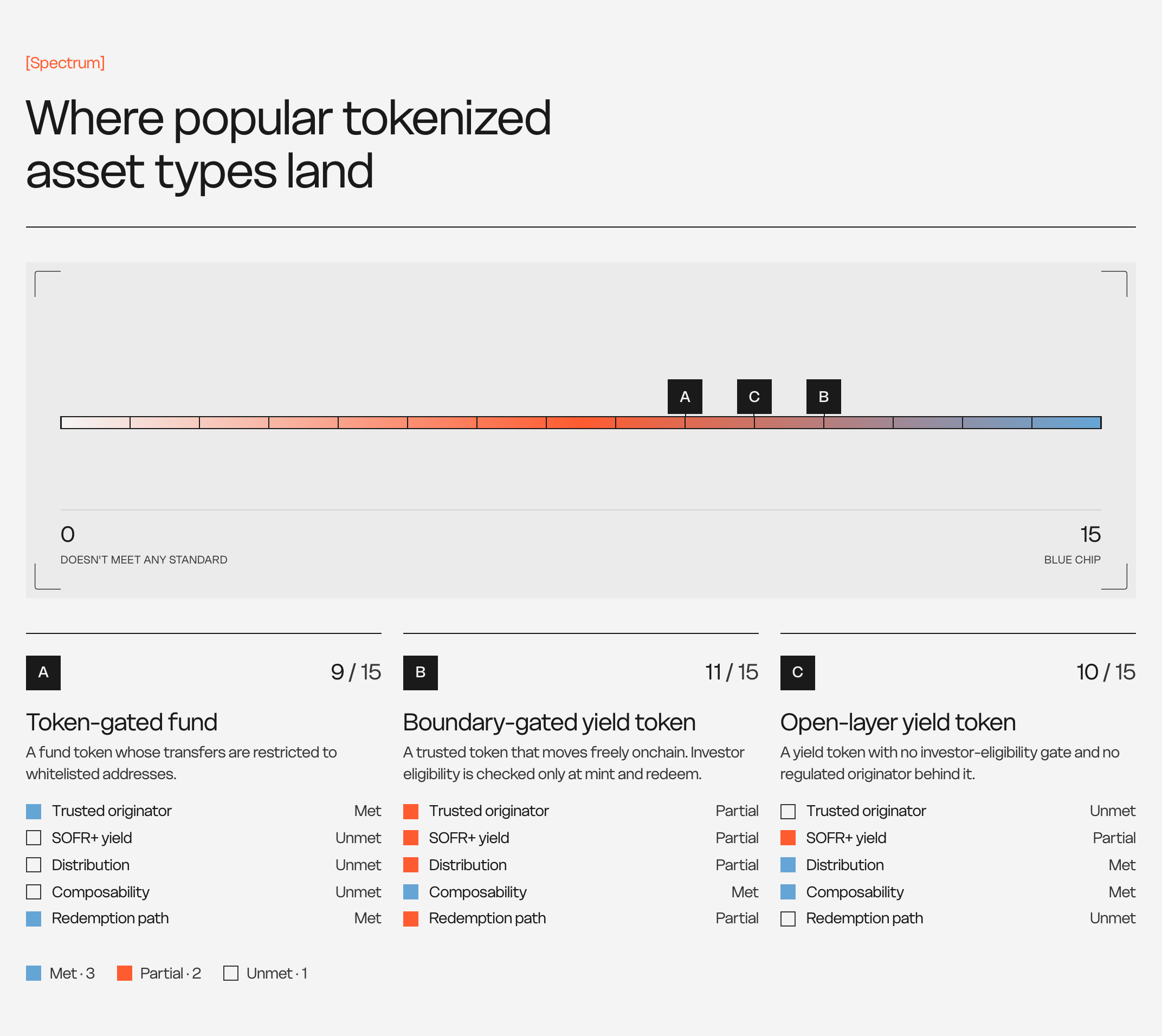
The scorecard
Evaluate a tokenized asset by these standards using the score card below, and join the Corda waitlist at corda.xyz and get early access to blue chip tokenized assets.